10 Watercolor Floral Clipart Wreath: Integrating High-Resolution Assets into Creative Workflows
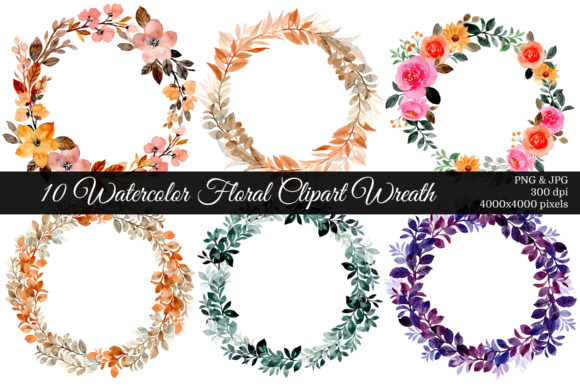
In the landscape of digital design and print production, asset management is often the bottleneck between concept and execution. For professionals ranging from wedding stationers to small business owners, the search for versatile, high-quality botanical elements can consume hours of billable time. The collection of 10 Watercolor Floral Clipart Wreath assets addresses this specific friction point by providing a curated library of pre-rendered organic frames. Rather than viewing these merely as decorative images, it is more practical to approach them as modular design components that streamline the production pipeline for invitations, marketing collateral, and digital content.
This resource pack includes 20 total files, offering each of the ten unique wreath designs in both PNG (transparent background) and JPG (white background) formats. With dimensions of 4000x4000 pixels at 300 DPI, these assets are engineered for professional-grade output. Understanding how to leverage this specific technical configuration allows creators to maintain consistency across mixed-media projects while significantly reducing the time spent on custom illustration or licensing negotiations.
Technical Specifications and Workflow Compatibility
Before integrating any asset into a production environment, verifying technical compatibility is essential to prevent downstream errors. The 4000x4000 pixel resolution places these watercolor floral clipart wreaths in the sweet spot for both large-format printing and high-density digital displays. At 300 DPI, this pixel dimension translates to approximately 13.3 inches by 13.3 inches of print area without interpolation. This means you can confidently use these wreaths as full-page borders on standard letter or A4 documents, or scale them down for business cards and tags without losing the delicate texture characteristic of watercolor media.
The dual-format delivery system supports distinct phases of the creative process. The PNG files with transparent backgrounds are the primary workhorses for layered compositions. They allow you to place text directly inside the wreath or overlay the foliage onto colored backgrounds and photographs without manual masking. Conversely, the JPG files serve a different utility. Because they come with a solid white background, they are optimized for quick placement in word processing software, basic office tools, or platforms that do not support alpha channels. Having both formats in the ZIP archive eliminates the need for format conversion, ensuring you have the right file type immediately available regardless of the software ecosystem you are currently using.
Pre-Production Planning and Asset Organization
Efficient design begins before opening your canvas. When working with a set like the 10 Watercolor Floral Clipart Wreath, organization dictates speed. Upon extracting the ZIP file, establish a naming convention that reflects the visual characteristics of each wreath rather than generic numbering. Renaming files to descriptors such as "Eucalyptus-Circle-Light," "Rose-Oval-Dense," or "Wildflower-Arch-Green" enables rapid retrieval during active design sessions. This semantic tagging reduces cognitive load when searching through assets mid-project.
For agencies or freelancers managing multiple client accounts, consider creating a master library link rather than duplicating the 20 files into every project folder. Using cloud storage aliases or local symbolic links ensures that if you update or correct a source file, the change propagates across all active projects. This preparation phase also involves checking color profiles. While these are typically RGB for digital versatility, professional print workflows may require CMYK conversion. Performing a test print or soft-proofing the watercolor floral clipart wreath against your intended paper stock early in the process prevents color shifting surprises during final production.
Application in Stationery and Event Design
The most immediate application for these assets lies in event stationery, where the balance between elegance and readability is critical. In wedding invitation suites, the wreath functions as a visual container that guides the eye toward central typography. When designing, treat the negative space within the wreath as an active layout grid. The 4000px width provides ample room for hierarchy; you might place the couple’s names in the optical center while utilizing the lower curve of the floral arrangement to anchor venue details or dates.
Beyond the main invitation, these assets provide continuity across ancillary pieces. A common workflow challenge is maintaining brand identity across disparate sizes. The same watercolor floral clipart wreath used on a 5x7 invitation can be scaled to 30% opacity for envelope liner patterns, cropped to focus on a single quadrant for place cards, or stretched vertically for menu headers. This modularity ensures that the entire suite feels cohesive without requiring the designer to create new illustrations for every individual piece. For DIY brides or budget-conscious planners, this versatility maximizes the value of a single purchase, allowing for professional-level coordination across save-the-dates, programs, and thank-you notes.
Digital Implementation and Content Creation
In digital workflows, file size and rendering behavior take precedence over print fidelity. While the source files are high-resolution, using the full 4000px PNG on a website or social media post will negatively impact load times and performance. A best practice is to create optimized derivatives specifically for screen use. Resize the watercolor floral clipart wreath to the exact display dimensions needed (e.g., 1080px for Instagram stories) and export as WebP or compressed PNG to preserve transparency while minimizing bandwidth.
For bloggers, educators, and marketers, these wreaths serve as effective framing devices for content. In presentation slides or webinar thumbnails, a floral border adds polish without distracting from the core message. The key is contrast management; ensure the text placed over or near the watercolor elements maintains WCAG accessibility standards. Because watercolor edges are naturally soft and variable, avoid placing critical legible text directly over detailed petal clusters. Instead, utilize the open spaces within the wreath composition or apply a subtle drop shadow to text layers to separate them from the organic background. This attention to usability ensures the aesthetic enhancement does not compromise functional communication.
Customization and Advanced Editing Techniques
While the 10 Watercolor Floral Clipart Wreath collection is ready-to-use, advanced users often integrate these assets into broader composite works. Non-destructive editing is paramount here. Always use smart objects (in Photoshop) or linked files (in Illustrator/InDesign) when placing these wreaths. This preserves the original 300 DPI data, allowing you to resize up or down later without quality degradation. If you need to adjust the color temperature to match a specific brand palette, apply adjustment layers above the smart object rather than altering the base pixel data. This keeps the asset flexible for future projects with different color requirements.
Layering is another technique that extends the utility of this pack. By combining two different wreaths at varying opacities or rotation angles, you can create a unique, denser botanical frame that appears custom-painted. This is particularly useful for luxury branding where uniqueness is valued. Additionally, because the PNGs have clean transparency masks, you can easily isolate individual flowers or leaves using selection tools if you need smaller accent elements. Breaking the wreath apart digitally allows you to scatter botanical motifs across a layout, turning a single frame asset into a comprehensive surface pattern kit.
Commercial Considerations and Quality Control
For entrepreneurs and publishers, understanding the licensing and quality boundaries of digital assets is part of risk management. Always verify the specific license terms associated with your download regarding commercial use, resale, and modification. While high-resolution assets like these are designed for professional output, they are generally intended for flattened end-products rather than redistribution as standalone stock. Integrating the watercolor floral clipart wreath into a tangible product or a flattened digital design protects both the creator's intellectual property and your business compliance.
Quality control should be built into the final export stage. Before sending files to print or publishing online, zoom to 100% to inspect the edges of the transparency mask. Occasionally, automated background removal can leave faint halos or jagged pixels. At 4000px, these artifacts are visible. A quick pass with a layer mask refinement tool or a feathered eraser can clean up edges, ensuring the watercolor blends seamlessly into your background. This level of detail distinguishes professional work from amateur assembly and justifies premium pricing for services or products utilizing these resources.
Long-Term Asset Value and Scalability
The true ROI of a digital asset pack is measured by its reuse potential over time. The 10 Watercolor Floral Clipart Wreath collection is designed with timeless botanical aesthetics that transcend seasonal trends, making it a permanent fixture in your resource library. To maximize long-term value, document successful applications. Keep a swipe file or mood board of layouts where these wreaths performed well. This historical data accelerates future decision-making, allowing you to replicate successful formulas for new clients or personal projects.
Furthermore, these assets interact well with emerging technologies. As AI-generated backgrounds and layout tools become more prevalent, having reliable, human-curated raster elements provides a necessary grounding. AI often struggles with consistent transparency and specific botanical accuracy; these hand-painted style clips offer authentic texture that synthetic generation cannot reliably reproduce. By anchoring modern automated workflows with high-quality, traditional-style assets, creators can achieve efficiency without sacrificing the organic warmth that audiences connect with emotionally. Whether used for a single greeting card or a scalable product line, treating these wreaths as foundational infrastructure rather than disposable decoration transforms them from simple downloads into enduring business tools.